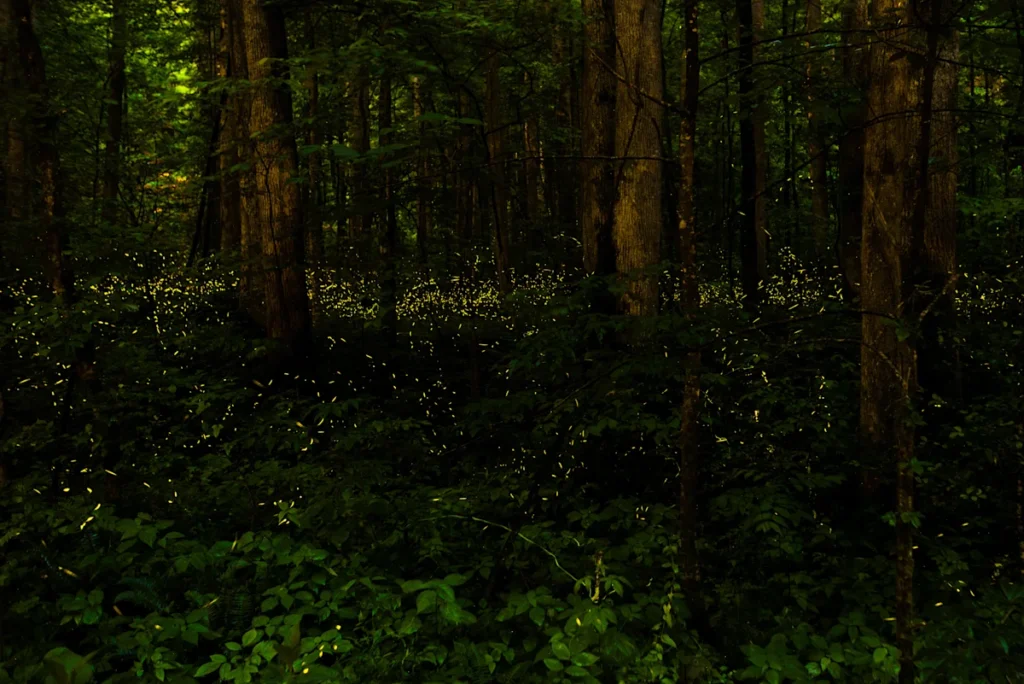


While visiting a friend outside Black Mountain, N.C., in the late spring of 2025, I sat on a porch and watched a whole valley blink, as though a constellation had been transposed from the night sky onto the forest below. It was revelatory. I hadn’t seen fireflies like that in ages. There, they glowed with the same abundance I remembered from childhood.
Researchers estimate that roughly one in three assessed North American firefly species is at risk of extinction. As such, I’d worried that nights full of fireflies were a thing of the past. Yet in that valley, they’d been abundant. Was I just looking in the wrong places?
To find out, I talked to Clyde Sorenson, an entomologist, wildlife biologist and distinguished professor at NC State University, about current firefly populations. While many species of lightning bug are in major decline, he says that “in North Carolina, for instance, we have 35 or so species of fireflies. Many of those species are doing quite well in habitats that are intact.”
Advertisement
Advertisement
Intact is the keyword. Here’s where to find fireflies in 2026, according to Sorenson, as well as how you can help this “charismatic microfauna” thrive in your own backyard.
What’s causing the decline?
Fireflies flash to find mates, and different species use different light patterns.
(Ali Majdfar via Getty Images)If you’ve walked the streets in your town on a summer night and had the sneaking worry that most of the fireflies you remembered from your youth are gone, you’re not entirely wrong. Sorenson says that “populations of common fireflies almost certainly have declined.”
However, scientists don’t know exactly by how much. “As cool as they are, we don’t know them very well,” Sorenson says. “We don’t even know, for that matter, exactly how many we have.” He notes that insects like honeybees have clear economic value. And while ecologically fireflies are “really important … the research that gets done on them is not as robustly funded as research on other kinds of animals,” he explains.
So what’s the main culprit for the decline? “The fragmentation, degradation and outright loss of the environments that these insects require,” Sorenson says. Fragmentation occurs when natural habitat is broken up by development — for example, when woodland is cleared for shopping centers or native landscapes are converted to manicured lawns.
Advertisement
Advertisement
A critical factor of degradation is light pollution. Lightning bugs flash or glow to attract mates. In many species, males fly while flashing to females in the grass below, using species-specific patterns. Light pollution can disrupt these habits. When it does, Sorenson called it “serious potential degradation.”
Yet some species are more affected by light pollution than others. Sorenson pointed to the common firefly, Photinus pyralis, nicknamed the “Big Dipper” for its J-shaped motion when it flashes. “This is a firefly that’s very well adapted to suburban habitats,” he explains. As dusk fliers rather than dark-night fliers, these lightning bugs do better in mixed environments where light sources intrude on their habitat. Sorenson says that night-flying firefly species are much more negatively impacted by light pollution.
When I asked Sorenson to what degree insecticides and localized mosquito treatments are a factor in population decline, he told me that “there has not been nearly as much work as there needs to be done on exactly how fireflies respond to insecticides.” Essentially, the impacts on fireflies remain understudied, while the harmful effects on pollinators like bees are “tremendous.”
Broader environmental conditions can affect populations too. “This year has not been a good year because of the drought [in the Southeast],” Sorenson says. “Drought’s not good for fireflies.”
What makes a healthy environment for fireflies?
Fireflies are actually members of the beetle family, rather than flies, as their common name suggests.
(Luc Pouliot via Getty Images)Intact environments provide homes for fireflies, and often it’s up to homeowners and community leaders to keep those habitats healthy.
Advertisement
Advertisement
While the drought that’s plagued the southern U.S. in 2026 has made it a poor year for fireflies, Sorenson says that “in normal years, I know many places where there are just insane populations of fireflies, and what these places have in common is they’re fairly large blocks of intact habitat, and they tend to be dark.”
“Most fireflies spend the bulk of their lives as little alligator-shaped predators running around under leaf litter or in the upper layers of the soil,” Sorenson adds. ”As much as one can, leaving natural habitats alone is probably the best thing you can do in terms of your immediate local firefly population.” In other words, let leaves remain on the ground and plant native flora to create habitats in your yard.
Sorenson says some habitats are more conducive to firefly populations than others. “Fireflies like moisture,” so species are found in woodlands and wetlands. Conserving these regions is pressing. “Wetlands are among the most threatened kinds of systems that we have,” he adds.
While protected areas like parkland often provide the conditions in which fireflies thrive, huge populations can also be found in the middle of cities and towns. He mentioned a greenway in Raleigh with a power line, where he finds “hundreds of fireflies of maybe three or four different species.”
Where to find fireflies in 2026 and beyond
Fireflies are still abundant through the dark woodlands and wetlands of much of the Eastern United States.
(Iris Huang via Getty Images)So can you still find robust communities of fireflies? Absolutely. “Go camping at a local state park during the right time of the year,” Sorenson says. “The bigger the park, the better.”
Advertisement
Advertisement
According to the Farmer’s Almanac, fireflies can come out as early as late April in the Deep South and along the Gulf Coast. In New England, they might appear from mid-June to early July. And in the Plains and Mountain States, lighter populations usually appear in early to mid-June.
According to Candace Fallon, senior endangered species conservation biologist at Xerces Firefly Atlas, most flashing fireflies will die out by August, “although several species in the South can be seen longer (like the Florida intertidal firefly, whose adults can be seen nearly year-round, and the Southwest synchronous firefly, whose adults are active through August and sometimes into September).”
National and state parks host abundant firefly populations. The Great Smoky Mountains are famous for their population of synchronous fireflies, which blink in coordination. “You can see 1,000 fireflies with one cast of your eye from one side to the other,” Sorenson says.
Beyond North Carolina, fireflies can be found across the Eastern U.S. and beyond. Any eco-tourism destination known for astronomy and dark-sky retreats located in lightning bug country would be a good place to look. For example, the Shenandoah Valley in Virginia, the marshland of Florida and the Catskills Mountains of New York all host these bugs. You can even find species of fireflies as far afield as the Pacific Coast, though many don’t flash as visibly.
Advertisement
Advertisement
“It’s not necessarily all that hard to find these places if you know what to look for and what you’re looking for,” Sorenson explains. “They’re all across the Eastern United States.” Still, he stressed, “As we continue to develop the landscape, those places become fewer and farther between.”
How to help with firefly conservation
Use the Xerces Firefly Atlas map to explore sightings of firefly species across the U.S. and record your own.
(Xerces Firefly Atlas)Thankfully, there are resources out there that can show you where to find fireflies, learn about them and help conserve them. One of these is Xerces Firefly Atlas, a joint venture between researchers and citizen scientists.
“Firefly Atlas is a collaborative community science project that allows both firefly enthusiasts and professional researchers to fill gaps in our understanding of our diverse firefly species in the U.S. and Canada,” says Richard Joyce, an endangered species conservation biologist at Xerces. “Equipped with a bug net, a camera and a sense of adventure, project participants conduct firefly surveys and share their data with a centralized database. Knowing which species live where provides a critical foundation for protecting and restoring firefly populations.”
The Xerces Firefly Atlas website features an interactive map that shows firefly sightings of specific species across the U.S. and beyond. The iNaturalist community has a similar database, though iNaturalist as a whole isn’t as focused on fireflies as Xerces is.
Meet our experts
Clyde Sorenson, entomologist, wildlife biologist and distinguished professor at NC State University
Candace Fallon, senior endangered species conservation biologist at Xerces Firefly Atlas
Richard Joyce, endangered species conservation biologist at Xerces Firefly Atlas
Source link