

To understand Slovenia, visit a beehouse.
In a meadow next to the Krakovski Forest in southeastern Slovenia, a gabled cottage doubles as an apiary with built-in beehives. Lavender perfumes the garden bursting with bee-friendly plants and medicinal herbs. Inside, the walls are covered with black-and-white photos of the family who has passed down their beekeeping know-how for generations. This idyllic place is called Zavod Čebela, and the beekeepers in charge are two queen bees: biologist Andreja Stankovič and her daughter Tjaša. Wearing a big grin and no protective gear, Andreja calms her hive with smoke. She gently removes a panel and bees crawl over her fingers. I’m hypnotized — and I only tried the honey liqueur, not the apitherapy remedies (like beehive air inhalation through a specialized mask, which is said to boost the immune system). Slovenia’s native Carniolan honey bee is said to be a good-natured type. And watching this, I’m convinced Andreja is a bee soother.
An apiary at Zavod Čebela (Bee Institute)
Credit: Photo by Karata Film for the Slovenian Tourist Board
Beekeeping plays a central role in Slovenian culture, an expression of the country’s sustainability ethos and connection to the environment. In a population of 2 million, some 11,000 beekeepers (about 1 out of every 200 people) perpetuate a centuries-old tradition. Bees play a critical role as pollinators, linked to a third of the world’s food production. Established by the United Nations at Slovenia’s initiative, World Bee Day is observed on May 20 to draw attention to the importance of bees for our ecosystems and food security. Here in Slovenia, the cuisine was “farm-to-table” before it became a buzzword, with kitchen ingredients gathered from gardens, foraged from forests, and fished from the Adriatic Sea.
Advertisement
Advertisement
Roughly the size of the state of New Jersey, this small European country punches above its weight in gastronomy. Traditional recipes reflect Slovenia’s geographic location at Europe’s heart, sandwiched between Austria, Croatia, Hungary, and Italy. It’s been marked by empires and historic trade routes. “Food migration didn’t stop at the borders,” says Gorazd Skrt, a private guide and tourism professional. Much of present-day Slovenia was part of the Austro-Hungarian empire until it fell after World War I, then joined its Slavic neighbors as part of the State of Slovenes, Croats, and Serbs, and then Yugoslavia in 1929. It’s been an independent country since 1991. “Slovenia’s cuisine is defined by three historic influences: the Austro-Hungarian empire, the Venetian Republic, and Balkan/Ottoman Turk,” Skrt says, while the Slovenian Tourist Board recognizes Alpine, Balkan, Mediterranean, and Pannonian influences. (Notably, the Ottomans taxed agricultural products, but not pigs, so there was a shift to pig production.)
Chef Ana Roš foraging
Credit: Photo by Ciril Jazbec for Ana Roš Group
Spice is an aromatic legacy. “The Venetians brought spices to Slovenia — we see them in old cookbooks,” explains Ana Roš, the celebrated, self-taught chef behind Hiša Franko, the country’s only three-Michelin-starred restaurant and a destination for culinary pilgrims. Historically positioned along the Venice-Vienna trade route, Slovenia incorporated cinnamon, clove, and cardamom into its specialities, a tradition that Roš continues to this day at Hiša Franko, in the Soča Valley beneath the towering peaks of the Julian Alps near the Italian border.
An ambassador for Slovenian gastronomy, Roš also runs a more casual place called Jaz in the capital of Ljubljana. The menu shows off Slovenia’s agricultural bounty, sourced from the city’s lively farmers market, with seasonal dishes like Piedmont-style agnolotti pasta stuffed with sunchokes, Adriatic sea bass ceviche in marinated strawberry juice with fermented rhubarb, and pepper-topped polenta with Zemljanka cheese — aged for four months underground.
Chef Ana Roš’s Summer Harvest dish at Hiša Franko
Credit: Photo by Ciril Jazbec for Ana Roš Group
Local sourcing still crosses borders. Another place of gourmet pilgrimage in the Julian Alps, the nature-inspired Milka restaurant channels a transnational approach, cooking with ingredients from nearby Italy and Austria. Chef David Žefran, who trained at Stockholm’s three Michelin-starred Frantzén restaurant, notes that Slovenian fine dining is “authentic and genuine,” with chefs recognizing the need for a tailored approach in a small country where the infrastructure will never cater to mass tourism. An example of this authenticity, and Žefran’s zero-waste and nose-to-tail philosophy, is an exquisite dish of chili-spiced pork cracklings which uses leftovers: The squash is poached in hay-infused butter and whey, a byproduct of dairy production usually fed to pigs.
Advertisement
Advertisement
Žefran grew up on a farm. Indeed many Slovenian chefs live close to the land. In the Dolenjska region in southeastern Slovenia, the sixth-generation Repovž restaurant is situated on the family’s organic farm, from which chef Meta Repovž riffs on traditional dishes like cottage cheese dumplings and lamb served in a variety of ways to utilize the whole animal. Manager Grega Repovž takes pride in pairing it with local wines from nearby vineyards.
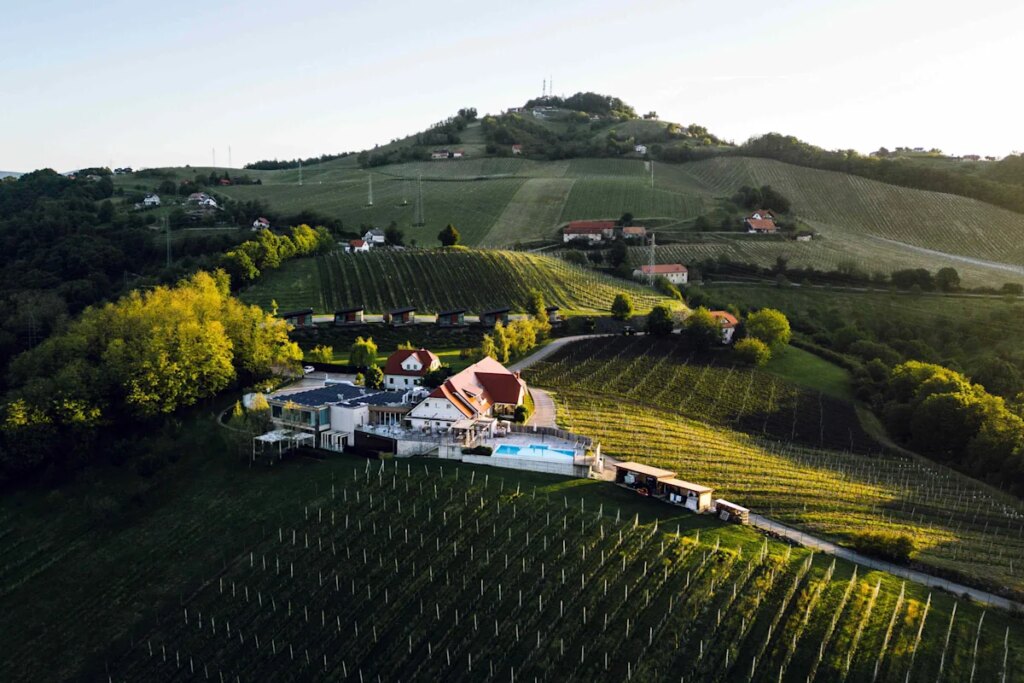
Keltis winery
Credit: Photo by Karata Film for the Slovenian Tourist Board
Indeed Slovenia’s wine culture is built on viticulture that goes back thousands of years. Maribor is home to the oldest grapevine that’s still continuously producing wine grapes (450 years old), and the indigenous Blaufränkisch grape variety is is recognized for its anti-aging properties, likened to “natural botox” by winemaker Matjaž Pavlin, whose thatched wine cottages in the vine-cloaked hillsides around Novo Mesto can be rented for an overnight stay. Beyond the Cviček table wines that Slovenians enjoyed for generations, high-quality standouts are now gaining international traction, like the biodynamic wines produced by family-run Keltis and the superb, Champagne-style sparkling wine crafted by Kozinc.
I ponder it at all during a meal at Osterija Debeluh (“Fat Tavern”), in the town of Brežice near the Croatian border. Hospitable owner Jure Tomič, awarded Chef of the Year 2026 by Gault & Millau, isn’t just a national sommelier champion. He also won Barilla’s World Pasta Championship in Turin in 2016. The pasta is perfection (goat cheese tortellini is served in milk cooked with lamb), yet it’s the signature beef tartare “cake” that steals the show: The meat is marinated in a cold broth of nutmeg, goose liver, and quail egg. Here in the gorgeous, unsung Posavje region, where the Krka River converges with the mighty Sava River, once an ancient fluvial trade route to the Black Sea, Osterija Debeluh celebrates the best of Slovenia.
Read the original article on Food & Wine
Source link